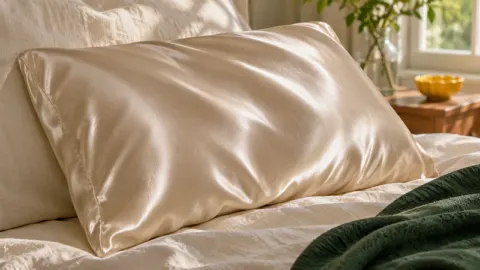
Pick by how you sleep
| Your situation | Start with | Why |
|---|---|---|
| You toss and turn, and your hair ends up off the pillow | Bonnet | It moves with your head, so your hair stays covered wherever you end up |
| Bonnets slip off you during the night | Pillowcase, or both | A pillowcase can't fall off. Pairing it with a bonnet gives you a backup |
| You find anything on your head uncomfortable, hot or too tight | Pillowcase | Nothing on your head, and nothing pulling on your hairline |
| You want to keep a set style, curls or a twist-out until morning | Bonnet, with hair loosely gathered | It holds the style together instead of letting it spread across the pillow |
| You share the bed, travel often or nap on the couch | Bonnet | It goes wherever your head goes |
| You'd like one option for hair and a smooth surface for your face | Pillowcase | Your face rests on it too. (Skin claims aren't well studied; see below) |
What dermatology sources actually say
- Both options are named, side by side. In its curly hair tips, the American Academy of Dermatology (AAD) says sleeping on a cotton pillowcase can create friction that makes hair frizzy and easier to break, and that satin or silk bonnets or pillowcases may reduce friction and preserve your hairstyle. The tips are credited to board-certified dermatologist Temitayo Ogunleye, MD. The same article suggests pulling curls into a loose ponytail or braid before bed.
- Pillowcases. University of Utah Health dermatologist Timothy Schmidt, MD, suggests silk or satin pillowcases because they create less friction than cotton, which can reduce potential hair breakage.
- Head coverings. The AAD says a head scarf or other covering made of silk or satin is gentler on hair than other materials. It also warns that the constant rubbing of a hat, head scarf or other covering can lead to traction alopecia, especially if hair is pulled back tightly first. Its advice is to pull your hair back loosely beneath the covering.
- What none of them say. We didn't find a dermatology source or published study comparing bonnets with pillowcases head to head. So no source tells you one beats the other. The choice comes down to how you sleep.
Bonnet vs pillowcase, point by point
| Satin bonnet | Satin pillowcase | |
|---|---|---|
| What it covers | Your hair | The pillow |
| If you roll off the pillow | Hair stays covered | Hair can land on cotton sheets |
| Can it come off? | Yes, if it's loose or the band is worn | No |
| Holds a set style | Keeps hair gathered in one place | Hair can still spread out and move |
| Fit and comfort | Can feel warm; a tight band presses on your hairline | Nothing on your head |
| Your face | No contact | Your face rests on it every night |
| Travel | Small and easy to pack in a tote | Needs a pillow to go on |
| Washing | Wash by its label | Wash by its label; see our washing guide |
Is a satin bonnet worth it for curly or natural hair?
For curly, coily and natural hair, the AAD's advice covers both options. It names satin or silk bonnets and pillowcases together. A bonnet's practical advantage is coverage: it keeps every strand off cotton, even if you move around. Its practical risk is fit. A band that's tight enough to leave a mark is pressing on your hairline every night, which goes against the AAD's advice to keep hair loose under any covering. If a listing gives a band size, measure around your head with a string and a ruler, the way our necklace length chart measures around the neck.
A pillowcase's advantage is that it needs no fit at all. Its limit is that it only helps where your hair touches it.
Neither one replaces the other basics in the same dermatology sources: going to bed with dry hair (University of Utah Health explains that water weakens hair's protein structure, making it easier to stretch and snap) and keeping bedtime styles loose.
Using both at once
You can use a bonnet and a satin pillowcase together. Nothing in the sources above says to choose only one, and the pillowcase gives you a backup if the bonnet slips off. A simple routine:
- Make sure your hair is dry, or close to it, before bed.
- Gather it loosely: a loose ponytail, braid, twists or a pineapple on top. Don't pull it tight at the hairline.
- Put the bonnet on so the band sits on your hairline without digging in. If it leaves a red line, it's too tight.
- Sleep on the satin pillowcase as usual. If the bonnet comes off, your hair lands on satin instead of cotton.
- In the morning, take the bonnet off and loosen your hair gently with your fingers.
Satin or silk: read the label either way
The comparison above is about the shape, bonnet or pillowcase, not the fiber. Both bonnets and pillowcases come in satin and silk, and dermatology sources name silk and satin together without ranking them.
"Satin" is a weave. A satin bonnet, pillowcase or other accessory can be polyester, nylon or silk. In the US, the FTC's textile rules require bedding, including pillowcases, to show fiber content, so check the label for a line like "100% polyester" or "100% silk." For a full comparison, see our satin vs silk pillowcase guide. Reading the label first is a habit across our guides, down to checking a bowl for a microwave-safe mark.
Questions people ask
Which is better for curly hair, a bonnet or a satin pillowcase?
The AAD names satin or silk bonnets and pillowcases together as ways to reduce friction and preserve your style, without saying one is better. If you move a lot in your sleep or want a style to last, a bonnet keeps your hair covered. If you can't keep a bonnet on or find it uncomfortable, a pillowcase works without any fit.
Is a satin bonnet effective?
For reducing friction, the AAD says satin or silk bonnets may help and that silk or satin head coverings are gentler on hair than other materials. We didn't find a published study measuring how much. Fit matters: keep hair loose underneath, because constant rubbing from a tight covering can lead to traction alopecia, according to the AAD.
Can you use a bonnet and a satin pillowcase together?
Yes. The pillowcase catches your hair if the bonnet slips off. Keep the bonnet band comfortable and your hair loosely gathered.
Satin bonnet vs silk pillowcase: which should I get?
They differ in two ways at once, shape and fiber. Shape decides coverage, so a bonnet covers your hair wherever you move. Fiber is a label question. Dermatology sources name silk and satin together, so choose the shape that suits how you sleep, then read the fiber line.
Can I sleep with my hair down on a satin pillowcase?
You can. The AAD's curly hair tips still suggest a loose ponytail or braid before bed, which keeps hair from tangling as you move.
Do satin pillowcases help your skin?
That's a different question from hair. As our satin vs silk guide explains, there isn't good published evidence either way for skin or acne. We don't make skin claims for either option.
Sources
- American Academy of Dermatology, "6 curly hair tips from dermatologists" (June 2022)
- American Academy of Dermatology, Hairstyles that pull can lead to hair loss (head coverings, silk or satin, pulling hair loosely)
- University of Utah Health, "Is It Bad to Sleep With Wet Hair?" (Sept. 2023)
- FTC, Threading Your Way Through the Labeling Requirements Under the Textile and Wool Acts (pillowcases covered by fiber content labeling)
Sources checked November 3, 2026.